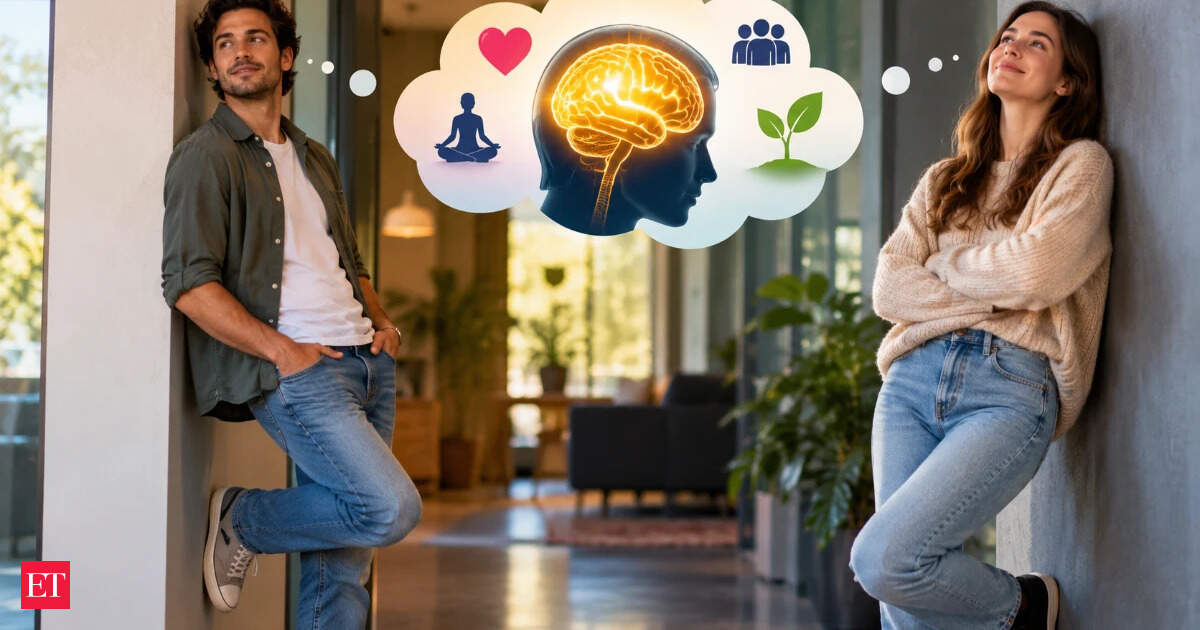
Picture yourself stepping into a bustling gathering, a networking mixer, or an unfamiliar social event. As conversations buzz around you, where do you naturally gravitate? For many of us, the instinct isn't to hold court in the center of the room. Instead, we scan the perimeter, quietly drifting toward a sturdy pillar, a doorframe, or a reliable expanse of drywall to prop our shoulder against.
While leaning against a surface might seem like nothing more than a casual attempt to take the weight off tired legs, behavioral science suggests our physical relationship with our surroundings often runs deeper. In psychology and nonverbal communication, physical posture frequently mirrors internal emotional states. When someone struggles to stand upright in the open and persistently searches for physical support, they might be responding to subtle psychological triggers—seeking something far more profound than mere physical comfort.
The Mind-Body Bridge: Posture as an Emotional Barometer
Our bodies are constantly communicating, not just to the people around us, but also back to our own nervous systems. Somatic psychology has long recognized that nonverbal behaviors—such as stance, spinal alignment, and how we occupy space—serve as real-time reflections of our inner equilibrium. When we feel safe, confident, and mentally grounded, our posture often reflects an open and self-supported stance.
Conversely, moments of unease or subtle social friction tend to register physically before we even consciously register them mentally. The instinct to lean, slouch, or anchor oneself against an external surface can serve as an unconscious coping mechanism designed to navigate social dynamics that feel overwhelming or energy-intensive.
Social Discomfort and the Mechanics of Postural Control
Academic research exploring human kinematics and clinical psychology highlights a clear link between social discomfort and postural behavior. Specifically, empirical investigations have identified distinct differences in postural responses among individuals experiencing social anxiety compared to their less anxious peers.
When social stress kicks in, the body's autonomic nervous system enters a heightened state of alertness. For people navigating social anxiety, this heightened state can subtly disrupt the balance and micro-adjustments required to maintain a relaxed, unsupported, upright posture. In clinical and laboratory observations, social pressure has been shown to alter balance dynamics, muscle tension, and spontaneous movement patterns.
In everyday environments, seeking out a wall can act as an intuitive strategy to counteract this tension. Leaning provides three key psychological and physiological benefits:
- Physical Grounding: Pressing against a solid structure offers immediate proprioceptive feedback—a sensory sense of where the body is in space—which can soothe an unsettled nervous system.
- Energy Conservation: Standing straight in the center of a room requires continuous muscular engagement and mental presence. Leaning offloads the physical workload during mentally draining interactions.
- Boundary Creation: A wall eliminates 180 degrees of vulnerability. By covering your back, you dramatically reduce the sensory data your brain needs to track in a crowded environment.
A Crucial Distinction: Context Over Diagnosis
While the psychological connections between posture and emotional states are fascinating, it is vital to approach them with balance and nuance. Leaning against a wall by itself is not evidence of anxiety or a psychological disorder.
Human movement is complex, and nonverbal behavior should never be analyzed in a vacuum. A persistent tendency to lean against walls, slouch against furniture, or avoid standing upright can easily stem from everyday, non-psychological factors, such as:
- Physical Fatigue: Simple exhaustion after a long workday or demanding workout often makes standing completely upright feel unappealing.
- Musculoskeletal Mechanics: Core muscle weakness, spinal misalignments, or conditions like hypermobility can make unsupported standing physically uncomfortable or tiring.
- Informal Social Norms: In many cultures and subcultures, a relaxed lean simply communicates an easygoing, approachable, or casual demeanor rather than distress.
- Sensory Regulation: For neurodivergent individuals, including those with ADHD or autism, firm physical pressure against a surface can be a helpful way to regulate sensory overload.
The Subconscious Shield: Why Perimeter Spaces Feel Safe
Evolutionary psychology offers another compelling layer of explanation for why so many people feel an irresistible urge to hug the walls. Throughout human history, positioning oneself with a clear view of an entire space while protecting one's blind spots was an intelligent survival tactic. Open, exposed spaces demand vigilant environmental tracking, whereas wall spaces offer immediate security.
When placed in modern environments that feel socially unpredictable—such as high-stakes cocktail parties or crowded public transit hubs—our evolutionary hardwiring can subtly prompt us to seek structural support. Backing up against a wall eliminates surprises and grants our brains a brief respite from constant social scanning.
How to Tune Into Your Body's Subtle Signals
If you recognize this habit in yourself, you do not need to abruptly force yourself into rigid, military-style postures. Instead, treat your body's leaning habits as an invitation for self-curiosity. The next time you find your shoulder glued to a wall, take a gentle mental inventory:
- Check Your Energy: Am I genuinely physically tired, or is my social battery running low?
- Scan for Tension: Are my shoulders hitched up toward my ears? Is my breath shallow? If so, the lean might be a response to environmental stress.
- Assess Your Surroundings: Do I feel safe, seen, and comfortable with the people in this room, or do I feel an urge to blend into the background?
Practical Steps for Finding Your Center
If you discover that your leaning habit often stems from social self-consciousness, practicing simple grounding techniques can help you feel secure without relying solely on physical structures for support:
- Cultivate the "Tripod" Foot Stance: When standing unsupported, distribute your weight evenly across the heel, the ball of the big toe, and the ball of the little toe on both feet. This simple shift signals stability directly to your vestibular system.
- Release Hidden Tension: Soften your knees slightly rather than locking them, and allow your diaphragm to expand with a deep, intentional exhale.
- Claim Your Space Mindfully: Remind yourself that you have every right to inhabit the room. Confidence is not about maintaining flawless, rigid posture; it is about feeling at ease within your own skin.
Key Takeaways
Our postural habits are rich with information. While leaning on a wall is a standard, comfortable behavior that should never be pathologized on its own, it frequently serves as a subtle mirror of our internal comfort level. Recognizing when your body is searching for security, stability, or rest allows you to honor your emotional needs with greater self-compassion and poise.
Source Attribution: Article content originally reported by Aastha Raj. Read original story coverage on Aastha Raj →