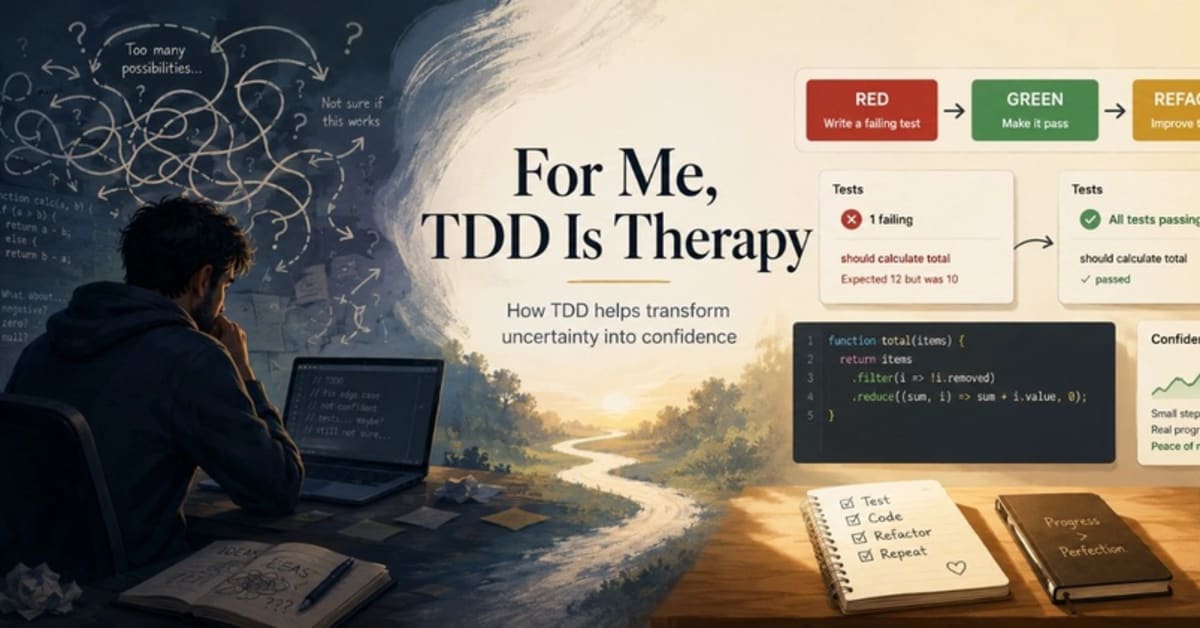
Have you ever sat in front of a blank screen, watching a blinking cursor while a subtle, persistent knot tightened in your chest? Whether you write code, manage complex projects, or navigate sprawling spreadsheets, that feeling is universally recognized: it is the paralysis of uncertainty. In the high-pressure ecosystem of modern software engineering, the demand to build flawless architectures on aggressive timelines regularly turns routine work into a catalyst for chronic stress and imposter syndrome.
For many engineers, however, the answer to this existential workplace dread was never found in mindfulness apps or ergonomic desk setups. Instead, it was found in an unexpected engineering methodology: Test-Driven Development (TDD). Far beyond a rigid technical dogma, TDD quietly evolved into a form of daily cognitive therapy—a structured psychological scaffold that turns terrifying ambiguity into manageable, bite-sized certainties.
Yet, as autonomous artificial intelligence tools and code-generation agents reshape modern workflows, that hard-won mental peace faces an unprecedented challenge. To understand why, we must first examine why writing tests first felt like therapy in the first place—and what happens to the human mind when that grounding ritual is disrupted.
The Anxiety of the Blank Canvas
Software development is fundamentally an exercise in navigating the unknown. Every new feature, architectural migration, or bug fix presents thousands of branching decisions. Without an anchor, this cognitive load quickly triggers executive dysfunction. When faced with a massive, undefined challenge, the human brain tends to catastrophize, asking unhelpful questions all at once: What if this architecture fails under load? What if I break an unrelated service? What if I don't actually know what I'm doing?
This mental friction leads directly to developer burnout, procrastination, and persistent anxiety. The brain perceives the massive, ambiguous task as an uncontrollable threat. To cope, developers need more than willpower; they need a system that systematically dismantles fear of the unknown.
Enter TDD: Cognitive Behavioral Therapy in Code
At its core, Test-Driven Development is famously defined by a simple, three-phase cycle known as Red-Green-Refactor:
- Red: Write a very small, failing automated test that defines one single thing your code should accomplish.
- Green: Write only the bare minimum code necessary to make that specific test pass.
- Refactor: Clean up, optimize, and streamline the implementation with the absolute confidence that your test suite will catch any regressions.
Viewed through the lens of psychological health, this cycle mirrors the foundational principles of Cognitive Behavioral Therapy (CBT) and grounding exercises. In CBT, patients struggling with overwhelm are taught behavioral activation and cognitive restructuring—breaking catastrophic problems down into tiny, low-stakes micro-tasks that can be objectively evaluated without emotional judgment.
TDD provides an externalized mental harness. When you practice TDD, you are forbidden from worrying about the entire system at once. You are only allowed to care about getting the next failing test to pass. By externalizing requirements into code, you offload tremendous pressure from your biological working memory onto the compiler. The green checkmark provides an immediate, tangible hit of dopamine—a clear biological signal of safety, progress, and control.
The Re-Emergence of Anxiety in the Age of AI Agents
If TDD restored psychological equilibrium to the craft of development, why has anxiety returned with a vengeance? The answer lies in the rapid rise of generative AI agents and autonomous code generation.
Today, developers are increasingly handing over the keyboard to autonomous tools capable of producing hundreds of lines of functional code in seconds. While the promise is hyper-productivity, the psychological side effect has been profound: the re-introduction of deep-seated anxiety and vigilance fatigue.
From Author to High-Stakes Inspector
When you write code deliberately through TDD, you understand every single branch and constraint intimately because you built the safety rail first. You have complete mental ownership of the system.
With AI agents, the developer's role shifts dramatically from an author to a forensic auditor. Instead of experiencing the calming, step-by-step assembly of a solution, you are suddenly confronted with an opaque block of pre-written logic. The questions that keep developers awake at night return with amplified force:
- Did the agent account for the edge cases I haven't even thought of yet?
- Are there subtle hallucinations, memory leaks, or security vulnerabilities buried in this instant output?
- If this service crashes in production at 2:00 AM, do I understand its internal machinery well enough to fix it under pressure?
Reviewing someone else's code—especially code generated in seconds by a non-human agent—imposes a far heavier cognitive burden than methodically writing your own. The loss of agency and the constant state of suspicious vigilance create a unique form of modern technical exhaustion.
Reclaiming Your Calm: Grounding Practices for the Modern Technologist
The solution is not to reject innovation or retreat into technological nostalgia. Rather, it is to recognize the psychological value of structured boundaries and adapt them to modern workflows. Here is how knowledge workers and engineers can preserve their mental well-being in an automated landscape:
1. Use Tests as AI Guardrails
Never ask an AI agent to build a feature from scratch without constraints. Instead, preserve your grounding ritual: write the failing tests yourself first. By authoring the test suite, you retain full ownership of the problem definition and establish clear, unambiguous boundaries. You can then prompt the agent to satisfy your tests, maintaining the psychological comfort of the green checkmark.
2. Protect the Micro-Step
When overwhelm creeps in, step away from macro-prompts. Resist the urge to ask tools to solve complex architectural challenges in a single breath. Break your user stories down into small, digestible units. The psychological benefit of small, predictable wins cannot be overstated.
3. Prioritize Mental Models Over Raw Velocity
Speed is an empty metric if it comes at the cost of chronic anxiety and cognitive alienation. Give yourself permission to slow down and trace generated solutions thoroughly. If you cannot explain why a piece of code works, reject it. Your long-term peace of mind is worth more than five minutes of saved typing time.
Key Takeaways for Mental Resilience in Knowledge Work
- Process Tames Panic: Systematic methodologies like TDD are psychological anchors that convert vague, overwhelming dread into clear, actionable steps.
- Cognitive Offloading Matters: Externalizing logic and criteria into automated tests frees up working memory, directly reducing workplace stress and burnout.
- Automation Carries Mental Costs: Shifting from active creator to perpetual reviewer induces vigilance fatigue and anxiety; intentional boundaries are required to combat it.
- Preserve Your Agency: Retain personal control over system design and validation, using automated tools as supportive assistants rather than unquestioned decision-makers.
Ultimately, software engineering—like any complex cognitive work—is as much an emotional journey as it is a logical one. Embracing structured, deliberate rituals is not slow or old-fashioned; it is a vital act of self-care in an increasingly chaotic technological landscape.
Source Attribution: Article content originally reported by Renan Franca. Read original story coverage on Renan Franca →